
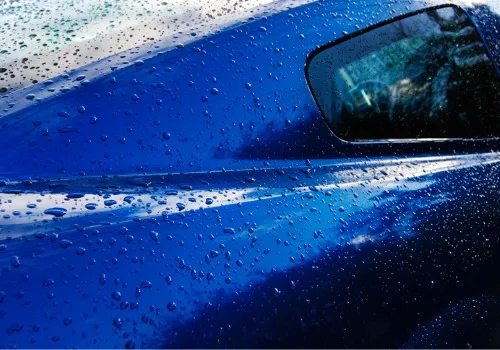
The water running through your car wash does more than you might think—and if it’s not treated properly, it can quietly eat into your performance and profits.
Most car washes rely on municipal water as their primary source. While that water is treated to meet safety standards, it is not conditioned in a way that’s optimal for car wash performance. Depending on where your operation is located, that water may contain high levels of minerals, dissolved solids, and other contaminants that directly impact your results.
Those issues don’t just show up on the vehicle—they show up in your equipment, your chemical usage, your maintenance schedule, and ultimately your bottom line. Over time, untreated water can lead to recurring customer complaints, more frequent repairs, and rising operating costs.
Understanding what’s in your water—and how it behaves in your system—is the first step toward running a more efficient, profitable car wash.
Before looking at regional differences, it helps to understand the three key factors that affect car wash performance: water hardness, TDS, and contaminants.
Water hardness refers to the concentration of calcium and magnesium in your water supply. These minerals are naturally occurring and enter water systems through rock and soil.
In a car wash environment, hard water becomes a mechanical problem. As these minerals move through your system, they begin to form limescale—a chalky buildup that coats heating elements, clogs spray nozzles, restricts flow, and forces pumps to work harder.
That buildup doesn’t just reduce efficiency—it shortens the lifespan of your equipment and increases how often you need service or replacement parts.
Total Dissolved Solids (TDS) measure the total amount of dissolved material in water, including minerals, salts, and other substances.
If hardness is what damages your equipment, TDS is what damages your results.
Even if water has been softened, it can still contain dissolved solids. When rinse water evaporates on a vehicle, those solids are left behind, creating the spots and streaks customers notice immediately.
Beyond minerals and dissolved solids, water can also contain contaminants such as nitrates, heavy metals, oils, detergents, and organic debris.
These contaminants vary by region, but in a car wash setting, they create two major problems:
As reclaim systems reuse water, these contaminants must be managed to maintain a clean, professional operation.
Water conditions are not the same everywhere—and for car wash operators, that difference matters more than you might think.
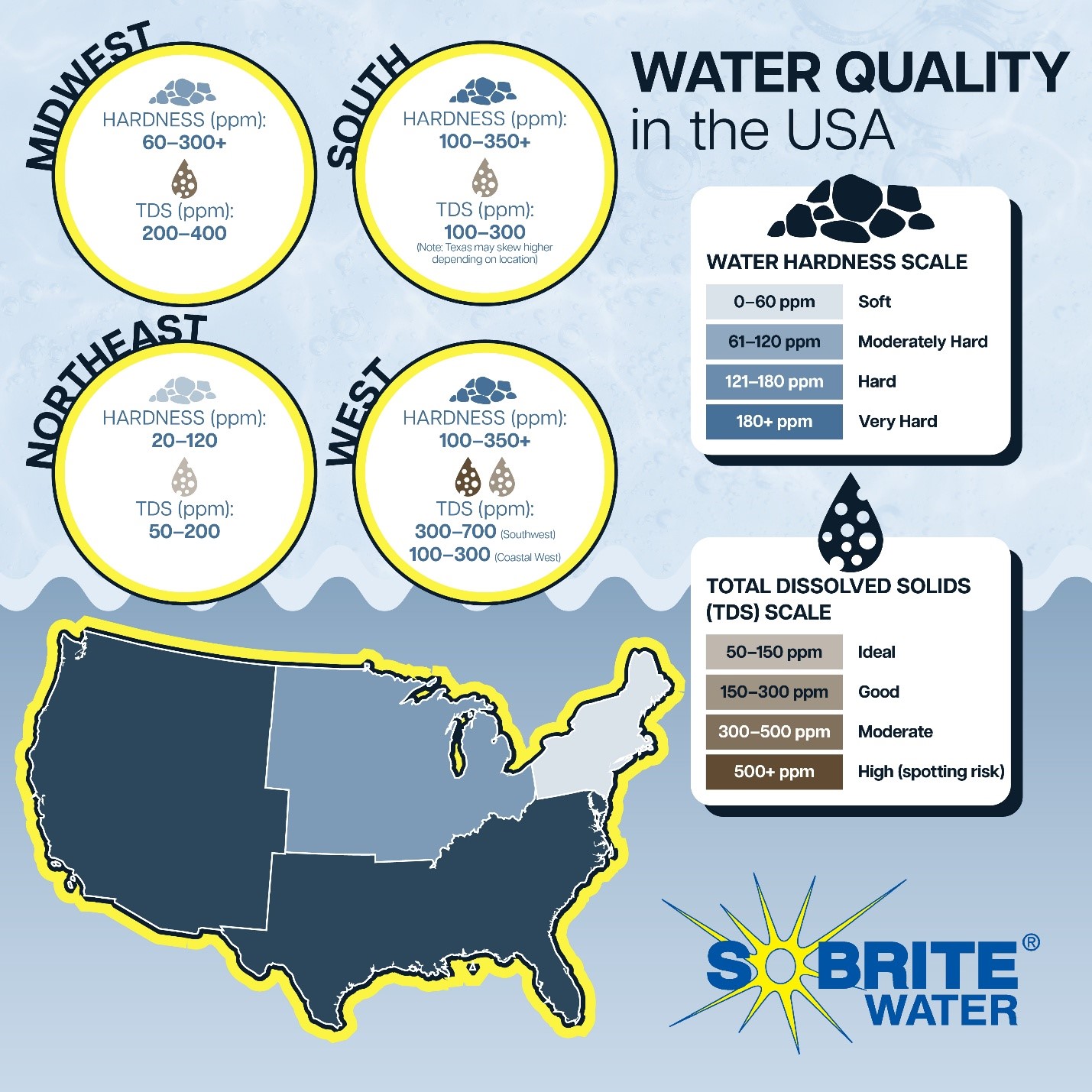
In the Northeast, water tends to be softer overall, typically ranging from about 20–120 ppm (parts per million, a measurement of how much mineral content is present in the water).
At first glance, that sounds like an advantage—and in some ways, it is. Operators in this region typically deal with less scale buildup and fewer equipment issues tied to hardness.
But that doesn’t mean the water is problem-free.
TDS levels still fall between 50–200 ppm, which means spotting can still occur, especially if no final treatment is in place. Additionally, aging infrastructure in many northeastern cities introduces contaminants like lead and PFAS, which can impact overall water quality and system performance.
The Midwest is where water conditions start to become more demanding for car wash operators.
Hardness levels commonly range from 60–300+ ppm, and that range shows up directly in day-to-day operations. Without treatment, operators often deal with clogged nozzles, reduced pressure, and more frequent equipment maintenance.
TDS levels between 200–400 ppm add another layer of challenge. Even if your system is running smoothly, those dissolved solids can leave behind spotting after every rinse.
On top of that, agricultural runoff introduces nitrates, fertilizers, and other contaminants into the water supply. That combination—hardness, TDS, and contaminants—makes untreated water in the Midwest one of the biggest hidden costs for operators.
Water conditions in the South are more variable, but in many areas—especially Texas—hardness levels fall between 100–350+ ppm.
For operators, that means inconsistent performance if water isn’t treated properly. Some days your wash results look great, and other days you’re dealing with spotting, chemical inefficiency, or buildup issues.
TDS levels typically range from 100–300 ppm, which can still contribute to spotting depending on local conditions.
In addition, industrial activity and infrastructure challenges can introduce contaminants that impact both water quality and reclaim system performance.
The Western U.S.—especially the Southwest—is one of the most challenging environments for car wash water.
Hardness levels frequently reach 100–350+ ppm, and TDS levels can climb as high as 300–700 ppm in inland regions.
For operators, this isn’t just a technical issue—it’s a daily operational hurdle.
High mineral content leads to constant scale buildup. High TDS leads to persistent spotting. And water scarcity pushes many facilities toward reclaim systems, which require proper treatment to maintain quality.
Without the right setup, these factors can quickly compound into higher costs, more maintenance, and lower customer satisfaction.
When water conditions are not addressed, the impact shows up quickly—and often more aggressively than operators expect.
Good news! Each of these water conditioning challenges has a proven solution—and when systems are combined correctly, they transform how your operation runs.
Water softeners remove calcium and magnesium before they ever enter your system, stopping scale buildup at the source.
This protects your equipment, improves chemical performance, and helps maintain consistent wash quality. For many operators, this is the first and most important step in a complete water treatment strategy.
If water spots are your biggest issue, reverse osmosis is the solution.
RO systems remove up to 99% of dissolved solids, producing ultra-pure water that dries without leaving residue. That means no spotting, no streaking, and a consistently high-quality finish that keeps customers coming back.
Water reclaim systems address one of the biggest operational costs in a car wash: water usage.
Instead of sending thousands of gallons down the drain each day, reclaim systems capture, clean, and reuse water—reducing both water and sewer costs while maintaining operational efficiency. In many cases, operators can reduce water usage by up to 70%, creating immediate savings.
Beyond cost savings, reclaim systems help manage contaminants, support environmental compliance, and give operators more control over their water supply.
As reclaim systems reuse water, managing bacteria and organic buildup becomes essential.
Odor control systems use UV and ozone-based treatment to eliminate odor-causing bacteria at the source, keeping your facility clean, professional, and welcoming.
Choosing the right setup isn’t about picking one piece of equipment—it’s about understanding how your water behaves and building a system around it.
While most high-performing car washes eventually implement a combination of systems, where you start often depends on your region and the biggest issue you’re facing.
Once your primary issue is addressed, the next step is building a system that works together.
In most cases, the best-performing car washes aren’t using just one system—they’re using a combination of all three, working together to control hardness, reduce TDS, and manage contaminants.
That’s where working with a partner like SoBrite Technologies makes a difference. Instead of guessing, you get a system designed specifically for your location, your water conditions, and your volume.
Water challenges don’t look the same in every part of the country—and your solution shouldn’t either.
SoBrite Technologies works with car wash operators across the United States, including Illinois, Iowa, Michigan, Wisconsin, Texas, Arizona, Nevada, and Southern California, designing systems that match the realities of each region.
Whether you’re dealing with hard water in the Midwest, high TDS in the Southwest, or variable conditions in the South, the goal is the same: consistent performance, controlled costs, and a better end result for your customers.
If you’ve been dealing with spotting, equipment issues, rising costs, or inconsistent results, your water is likely the root cause.
The good news is you don’t have to figure it out on your own.
SoBrite Technologies works directly with car wash owners to evaluate water conditions, identify problem areas, and design systems that solve them. From initial assessment to installation, training, and long-term support, the focus is on helping your operation run more efficiently and deliver better results.
Contact us today to start the conversation:
809 W. Center St. Eureka, IL 61530 USA info@sobrite.com 309-467-2335 Mon-Fri: 8:00 am – 5:00 pm
If you’re seeing spots after the final rinse, you’re looking at dissolved solids left behind as the water dries. Even clear water can carry minerals and salts (TDS), and once the water evaporates, those solids stay on the surface. The higher the TDS, the more noticeable the spotting.
It is—and it usually shows up faster than people expect. Hard water leaves behind scale inside nozzles, lines, and heaters. Over time, that buildup restricts flow, reduces pressure, and makes your equipment work harder than it should.
TDS stands for Total Dissolved Solids. Think of it as everything dissolved in your water—minerals, salts, and other substances. In a car wash, high TDS is what leads to spotting and streaking, even when everything else in your process is working correctly.
In many cases, yes—and they solve different problems. A softener protects your equipment by removing hardness, while reverse osmosis handles the finish by removing dissolved solids. If you want both reliability and spot-free results, they typically work best together.
Reclaim systems capture water from your wash process, filter out debris and contaminants, and send it back into circulation. Instead of constantly pulling fresh water, you’re reusing what you already have—reducing both water usage and sewer costs.
Absolutely. Most operators don’t start with a perfect understanding of their water—they just know something isn’t working the way it should. SoBrite helps identify what’s going on, then recommends a system (or combination of systems) that fits your operation and your region.


